
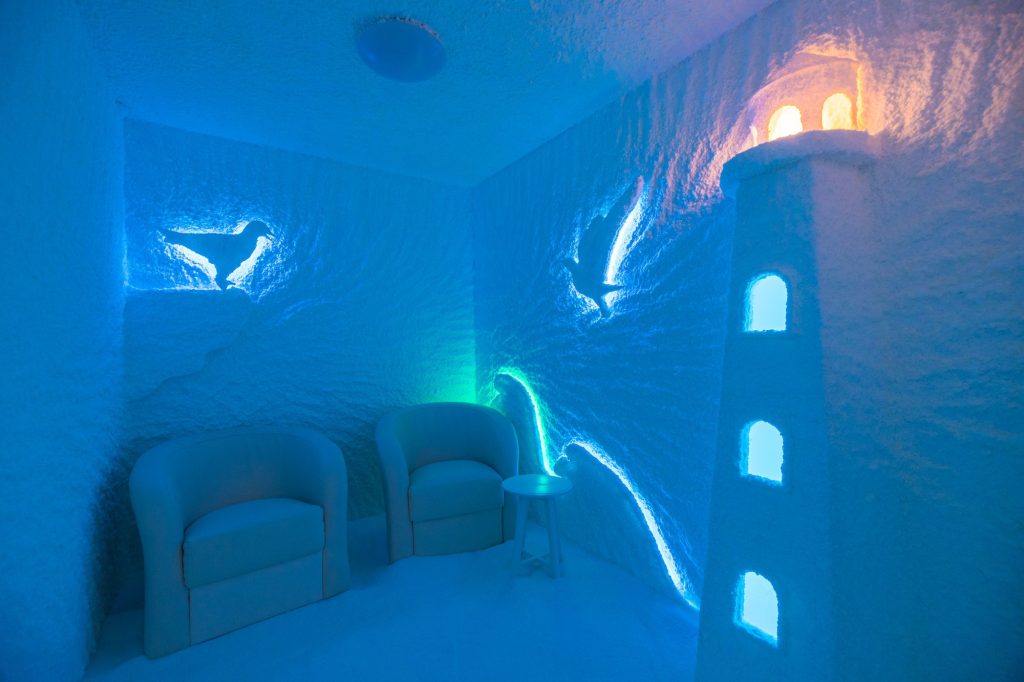
Halotherapy explained
Where the name comes from
The word halotherapy comes from the Greek word for salt, hals. It describes time spent in a room where a fine dry salt aerosol is present in the air. The practice was inspired by speleotherapy, the custom of spending time in natural salt mines and caves, and brought that environment above ground into purpose-built salt rooms.
Dry salt aerosol and wet salt mist
Not every product with salt in its name works the same way. A halogenerator grinds dry, pure salt into very small particles and blows them into the room as a dry aerosol. Nebulizers and salt diffusers, on the other hand, turn a salt solution into a wet mist. Salt walls and salt lamps add atmosphere, but they do not release salt particles into the air on their own. When people speak of halotherapy, they usually mean the dry salt aerosol produced by a halogenerator.
Why particle size matters
The size of the salt particles decides how they behave in the air. Very fine particles stay suspended in the room for longer and spread evenly, while coarse particles quickly fall to the floor. VivaSalt halogenerators grind salt into particles between 0.3 and 5 µm and release only the finest fraction into the room.
Which salt is used
Only dry, pure salt without additives such as anti-caking agents or iodine is used in a halogenerator. Additives and moisture can clog the mill and change the quality of the aerosol. That is why we supply our own VivaSalt salt for halotherapy.
How a visit to a salt room looks
Guests sit or recline in a dimly lit salt room, often with quiet music, while the halogenerator runs in the background. A session commonly lasts around 20 minutes for children and around 40 minutes for adults, but every salt room operator sets its own schedule. Between sessions the room is ventilated and the halogenerator is refilled if needed.
Halotherapy at home
A dedicated salt room is not the only option. Mobile halogenerators such as VivaSalt Family, Power or Lux can be placed in a small room, an infrared sauna, a cabin or a tent at home, and they are operated with a single button or a touch screen.